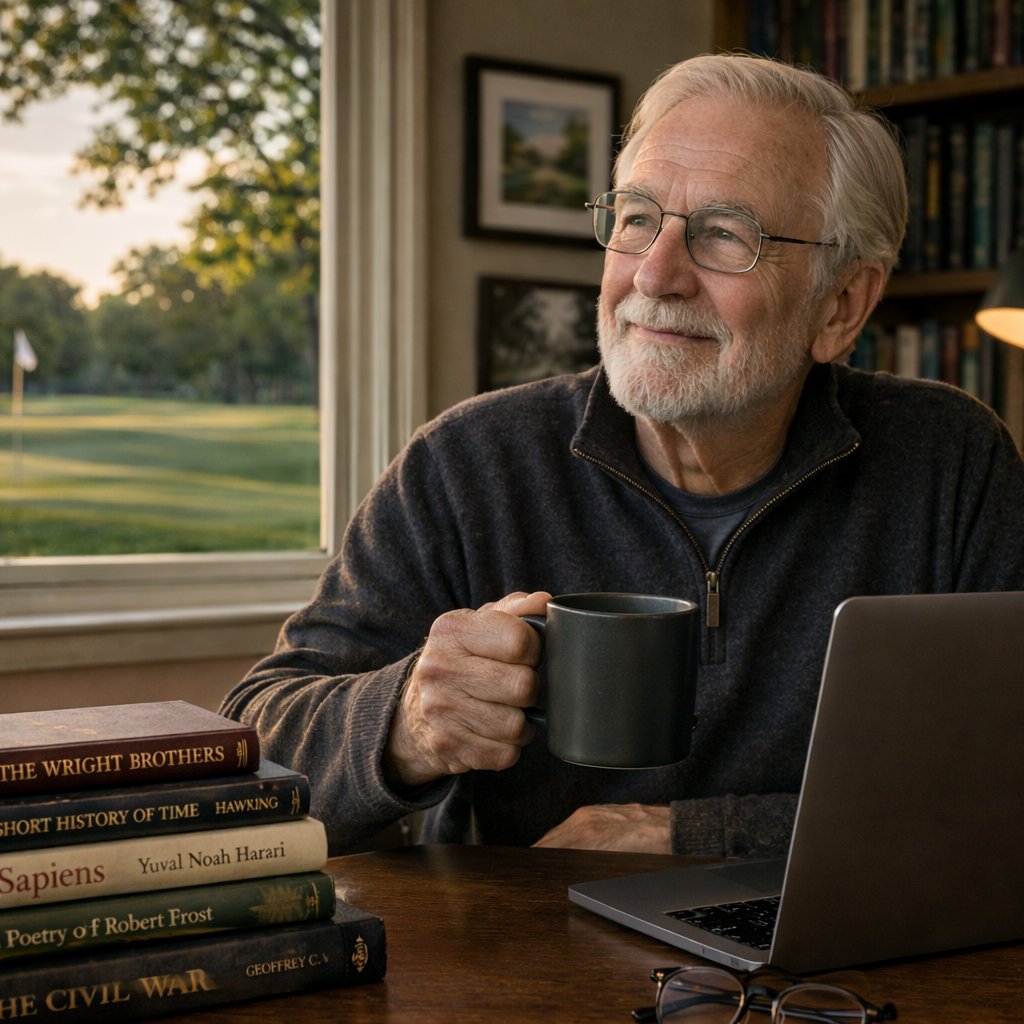
I don't play golf. It's not for lack of trying. My father-in-law played most of his life. At his peak he had a zero handicap. He was club champion year after year. At age 75 he set a course record at a championship course in Puerto Rico. Whenever we visited him in Florida, he insisted I take lessons (and buy things at the pro shop I was never going to wear). Eventually, we went out together one morning to play nine holes. After watching him hit a perfect tee shot — 250+ yards, straight down the fairway — I stepped up and sent mine at a 90-degree angle… directly into a tractor being driven by one of the grounds crew. Fortunately, he was in a cage. So, no — I won't be spending my "golden years" working on my golf game.
I have been a caregiver to my wife of 42 years, who was diagnosed with Parkinson's Disease 20 years ago. As a result, I am home a lot every day. I read. I write. I take vigorous walks. I go to the gym six days a week. Minimum. But there is something quietly isolating about those pursuits.
And then, quite recently, AI entered my life. Not as a tool or a novelty. And certainly not as an emotional advisor. But as a thought partner. I now spend hours each day exploring ideas — science, math, finance, economics. It is like having a private tutor who is infinitely patient, endlessly curious, and always available. Not always right — but then, neither are most people. The key is that it is "interested" in what fascinates me, invites engagement, and encourages me to explore deeper. All you need is curiosity and a bit of imagination.
For someone about to turn 73, that has been life changing.
It hasn't given me more time. It has given me more ways to explore the world with the time I have left.
No — it hasn't improved my golf game.
But who cares.