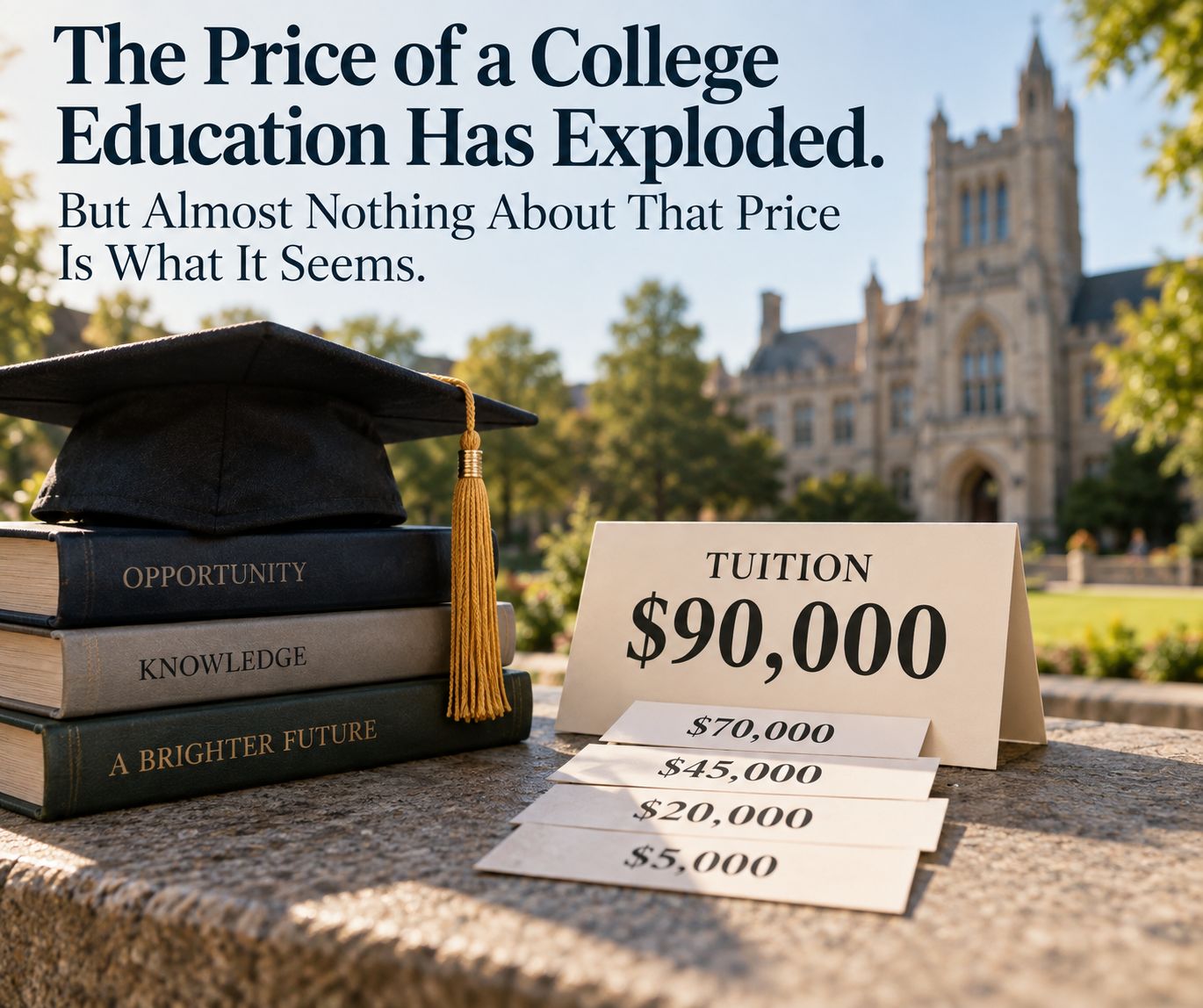
Over the past week or so, I have been thinking a great deal about the price of a college education. I graduated from college in 1975, and the fifty years since then struck me as an interesting period to examine — perhaps because I recently used the same fifty-year perspective to look at changes in the federal budget.
I have had a tangential relationship with higher education, having spent a number of years as an adjunct professor. From time to time, I definitely wondered how the families of my students could afford the costs and I pondered whether they were getting good value for all the money they were spending. And, of course, the high price of a college education is regularly in the news — the numbers making eye-catching headlines, the causes identified, the villains identified and blamed. All of this has left me wondering what has actually happened.
My recollection is that my parents paid roughly $4,000–$5,000 a year for my tuition, room and board at Brandeis University. As an aside, I will mention that I wished that they had paid just a bit more — the food at school was simply horrendous. In any case, today the published price for what I think are fundamentally the same items (hopefully better food) is about $90,000. That represents a nominal annualized increase of roughly 6% compounded over fifty years. The obvious questions seem simple enough. Has providing a college education really become that much more expensive? What else has been going on? And how can families possibly afford it?
The comparison above in nominal dollars is dramatic, but dollars separated by fifty years obviously aren’t comparable. Except where specifically indicated otherwise, the historical comparisons that follow are therefore adjusted for inflation (i.e. computed in real dollars).
I began this exercise expecting to find a relatively straightforward explanation for why college had become so expensive. I didn’t. Instead, I found that even seemingly simple terms such as price, cost, discount and affordability become surprisingly complicated when applied to our system of higher education.
Here are five insights that particularly struck me.
1. The increase did not occur steadily over fifty years.
First, the chronology of price increases surprised me. In inflation-adjusted terms, the published price of private college was roughly stable during the 1970s. The dramatic increase began around 1980.
From 1979–80 to 1994–95, inflation-adjusted tuition, room and board at private four-year colleges increased approximately 71%. Large real increases continued for another couple of decades.
Then something happened. For the broad private nonprofit sector, the real published price has barely increased over approximately the past decade. In constant 2025 dollars, average published tuition plus housing and food was about $59,600 in 2015–16 and $60,900 in 2025–26 — an increase of only about 2%.
So, there wasn’t one uninterrupted fifty-year tuition explosion. There were distinct periods: relative stability, followed by approximately three decades of extraordinary increases, followed by another period of relative stability.
For me that raised questions rather than answered them. What changed around 1980? And why did the forces that had pushed real prices upward for decades apparently become much weaker around 2015?
Any credible explanation for the extraordinary increase in college prices needs to account for that chronology.
2. Providing college education really did become more expensive — but nowhere near as much as published tuition increased.
This may have been the most important thing I learned.
Historical NCES data for private nonprofit four-year colleges show that inflation-adjusted institutional educational spending per full-time-equivalent student increased approximately 30% between 1980 and the mid-1990s, excluding scholarships and fellowships. Over roughly the same period, published tuition increased something on the order of 80–90% in real terms.
There were apparently two different phenomena occurring simultaneously. Colleges really were spending substantially more to provide an education. But the published price was increasing far faster than the underlying expense.
The composition of the spending increase is also revealing. Between approximately 1980 and 1995, in real dollars:
| Category | Increase |
|---|---|
| Instruction | ~27% |
| Administration | ~35% |
| Student services | ~55% |
| Research | ~20% |
| Libraries | ~11% |
| Plant operations | ~0% |
There is obviously no single culprit. Administration costs increased faster than instruction, but student services increased considerably faster than either. However, the cost of instruction itself increased almost as much as overall underlying educational spending. Employee compensation and particularly benefits also became more expensive.
This makes simple explanations such as “administrative bloat” emotionally appealing but intellectually totally unsatisfying. The institution itself became more expensive, with spending increasing across several different functions rather than being concentrated in one single category.
But none of that explains why the published price increased roughly three times as much as the expense of providing it. That requires looking at price rather than cost.
3. The published tuition price gradually stopped functioning like an ordinary price.
Private colleges increasingly adopted what is commonly called a “high-tuition/high-aid model.” Instead of establishing one price that most students paid, colleges established a high published price and then reduced that price selectively and often aggressively through institutional financial aid.
The magnitude of change over time is extraordinary. The institutional tuition discount rate — the share of gross tuition and fee revenue that institutions forgo through their own grants and scholarships — was roughly 24% in the mid-1990s. By 2000 it was around 30%; by the mid-2000s, roughly 34%. Today it is approximately 50% for all undergraduates at the institutions covered by the NACUBO survey, and even higher for first-year students.
Once discounting reaches this magnitude, the sticker price means something quite different from an ordinary retail price. It becomes more like the top of a pricing schedule. One student might pay the entire published tuition. Another might pay $50,000. Another $25,000. Another almost nothing. And they sit in the same classroom receiving essentially the same education.
The airline analogy is tempting. Airlines learned long ago to charge different customers different prices for substantially the same seat according to their willingness to pay. But colleges have a more complex and challenging goal: they care deeply about which customers buy their product.
Financial aid can therefore serve two purposes. Need-based aid allows the institution to vary price according to a family’s financial resources. Merit aid and other institutional grants allow it to vary price according to how much the college wants a particular student.
When an institution can charge different customers different amounts, there is no reason its maximum price must be determined primarily by its expense of producing the education. The upper end of the pricing schedule can instead be determined by what the families with the greatest willingness and ability to pay will bear. The relationship between price and cost can become exceedingly attenuated, if not wholly divorced.
This helps explain how published tuition could increase dramatically without requiring us to conclude that providing the education itself became correspondingly more expensive.
The more recent data reveal another interesting development. College Board reports that average real net tuition at private nonprofit four-year colleges declined from $19,810 in 2006–07 to $16,650 in 2021–22, a decline of approximately 16%. Tuition, however, is only one source of institutional revenue. Colleges also finance their operations from endowment income, gifts, government grants and contracts, and other sources. The mix varies enormously among institutions.
4. A tuition “discount” is not the same thing as a subsidy.
This distinction had never occurred to me before looking at the numbers.
Suppose a college publishes tuition of $70,000 and gives a student a $30,000 institutional grant. The student has received what the college describes as a $30,000 tuition discount and pays $40,000.
But suppose the institution spends $35,000 to provide the relevant education. Has it subsidized that student?
Not in this simplified example. Despite receiving a $30,000 “discount,” the student is still paying $5,000 more than the expense of providing the education.
Another student at the same institution might receive a $60,000 grant and pay only $10,000. That student really would be receiving a substantial institutional subsidy.
The important point isn’t the hypothetical numbers. It is that discount and subsidy use entirely different reference points. A discount measures the reduction from the published price. A subsidy would have to measure what the student pays relative to the institution’s expense of providing the education.
I did not find data precise enough to compare what individual students pay with the cost of educating them. And average institutional spending per student is not the same thing as the cost attributable to any particular undergraduate. But the conceptual point is clear: a tuition discount tells us nothing, by itself, about whether an institution is subsidizing a student’s education.
That makes statements such as “our tuition discount rate is 50%” considerably less informative than they initially appear. The discount is measured from a sticker price that the institution itself established as part of its pricing system — a price increasingly influenced by what the market will bear rather than being closely tied to the expense of providing the education.
5. Student loans changed what it means to say that a family can “afford” college.
Federal student loans add another dimension to the system and complicate the analysis.
Without borrowing, a family’s ability to pay for college is largely constrained by current income and accumulated savings. Student lending adds another resource: future income. A student loan essentially allows part of today’s tuition to be paid from earnings that may not be received for many years.
That unquestionably changes who bears the financial burden and when. A college collecting $40,000 doesn’t particularly care whether $10,000 of it came from the family’s savings or from loan proceeds. The institution receives $40,000 today. But for the family and student, the economics are very different. Part of the cost has been transferred to the student’s future earnings.
Greater borrowing capacity may also allow institutions to charge more than they otherwise could. If customers can borrow against future income, their ability to pay today’s price increases. There is empirical evidence that increases in federal lending limits have been associated with increases in tuition and, in some cases, reductions in institutional grant aid.
I am reluctant to conclude too much from this. In my opinion it is not established that federal student lending “caused” the enormous increase in college tuition. Plainly many other forces have been at work. But student lending clearly fits neatly into the economics of a high-price/high-aid system. Financial aid can reduce what a student is charged. Borrowing does not reduce the price at all; it changes when the price is paid.
Some of what is often described as making college “affordable” may therefore mean something quite different: shifting part of the price from parents’ current resources to students’ future income.
Conclusion
I started with what seemed to me a straightforward and important question: How did the $4,000–$5,000 my parents paid for my education become a published price of roughly $90,000 fifty years later? I ended up thinking that the question itself was too simple.
Providing a college education really did become more expensive. But its published price increased much faster. That published price subsequently became the starting point for an elaborate system in which different students pay dramatically different amounts. A “discount” from that price does not necessarily represent a subsidy. And borrowing can make an otherwise unaffordable price manageable today by transferring part of the burden into the future.
None of this tells us what college should cost, whether today’s prices are justified, or whether the system is fair. Those are different questions. What it does suggest is that asking “Why does college cost so much?” conflates several different things. After spending a week looking at the numbers, I am no longer certain that cost is even the right word.
Sources and Further Reading
https://nces.ed.gov/programs/digest/
https://nces.ed.gov/pubs2002/2002158.pdf
https://research.collegeboard.org/trends/college-pricing
https://research.collegeboard.org/media/pdf/trends-2010-tuition-discounting-institutional-aid-report.pdf
https://www.nacubo.org/Press-Releases/2025/NACUBO-Study-Finds-Private-Colleges-and-Universities-Are-Offering-Record-Financial-Aid-to-Students
https://www.newyorkfed.org/research/staff_reports/sr733.html
https://www.brandeis.edu/registrar/bulletin/provisional/financial-information/tuition-fees-expenses.html