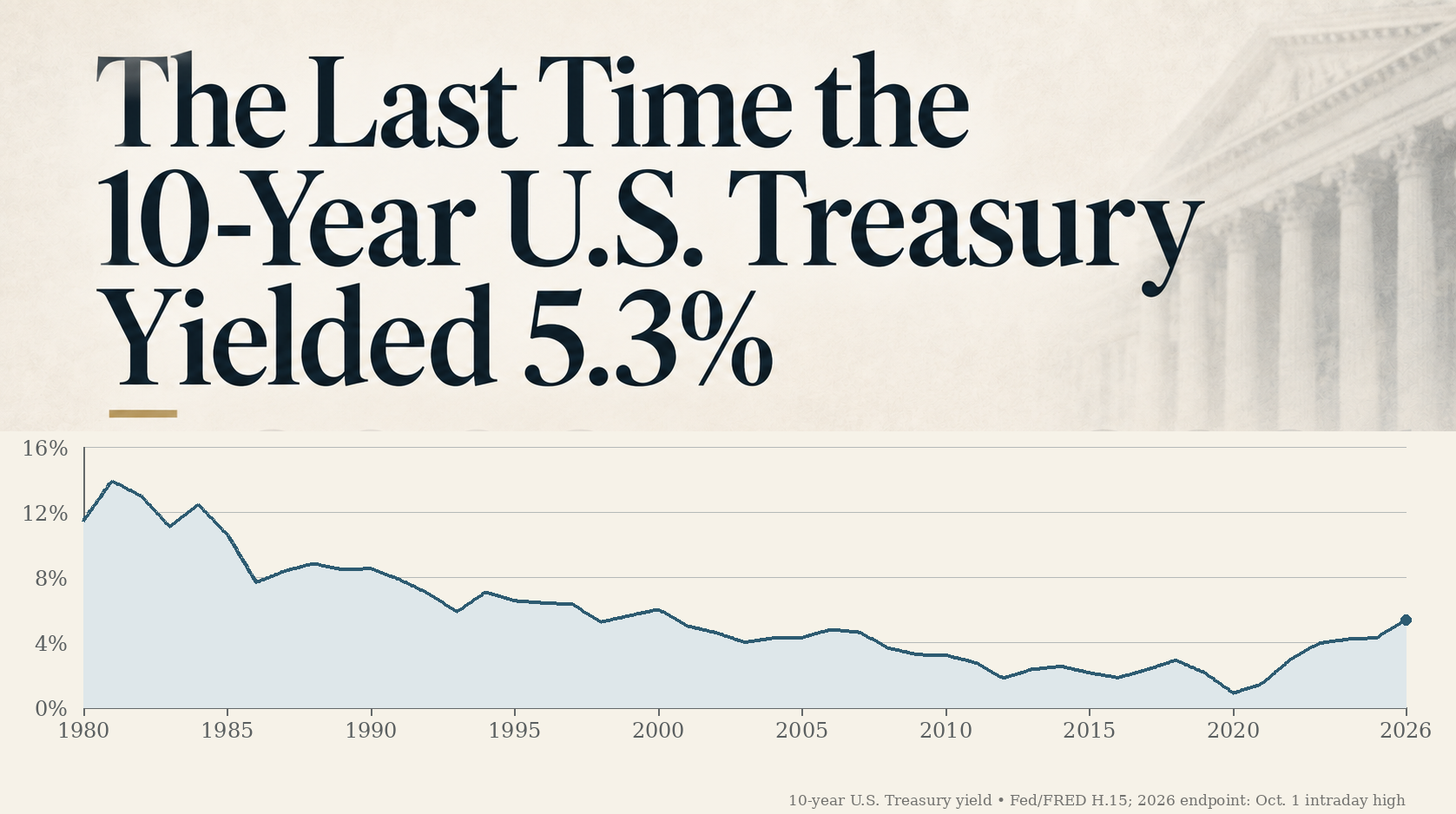
Earlier this month, the yield on the 10-year US Treasury briefly reached 5.34%, its highest level since 2002. Judging from the financial headlines, you might have thought we had entered completely uncharted territory. Nothing could be further from the truth.
I am old enough to remember, without doing any research, when a 5% interest rate would hardly have attracted attention. For those whose frame of reference is principally the years since the Global Financial Crisis — the Fed Funds rate held close to zero, quantitative easing and the pandemic — a 10-year US Treasury yielding more than 5% looks extraordinary. Stretch the frame back a few decades and it looks considerably less so.
Which got me wondering: What did the world look like the last time the ten-year US Treasury was yielding approximately what it yielded earlier this month? It turns out to be an interesting trip back in time.
In the spring of 2002, the Fed funds rate was only 1.75%, down from 6.5% less than two years earlier as the dot-com boom collapsed and the economy entered recession. Consumer prices in April were just 1.6% higher than a year earlier, while unemployment had risen to 5.9%. The economy had emerged from recession, but the recovery was hardly robust.
Wall Street was still dealing with wreckage from the dot-com bubble. The Nasdaq had collapsed and 2002 would become the broader market’s third consecutive down year. Enron had filed for bankruptcy months earlier; WorldCom would follow in July after disclosing billions of dollars of improperly accounted-for expenses. Congress responded that summer with the Sarbanes-Oxley Act.
September 11 was only seven months in the past. American troops were fighting in Afghanistan and the cleanup at Ground Zero was still underway. Attention in Washington was increasingly turning toward Iraq; the invasion was still almost a year away.
The United States had recorded a budget surplus in fiscal 2001. The Congressional Budget Office had projected cumulative surpluses of $5.6 trillion over the following decade. The budget was back in deficit in 2002.
In 2002 there was no iPhone, Facebook, YouTube or Twitter. Google was still privately held and would not go public until 2004. Apple’s relatively new breakthrough product was the iPod. Amazon existed, but in 2002 it had sales of less than $4 billion and was still losing money.
I remember quite distinctly the frustration of trying to connect to the Internet. You needed local phone numbers for your Internet Service Provider and a dial-up modem. It could take several attempts before you finally got through the crackling noise and were connected.
The world in 2002 was indeed a very different place. But one thing that would not have seemed particularly remarkable was a 10-year US Treasury yielding a little over 5%.
Twenty-four years isn’t an especially long time. Apparently it is long enough for both the world — and our idea of what constitutes a high interest rate — to change quite a bit.